



Resource
News
If you leave a question, we will respond quickly and kindly.
“World OKTA Invests 2 Billion Won in Home Country Startups for Next-Generation Startups”
- Date : 2026.04.06 13:50
Interview with Lee Sunghak, Co-founder of PROVEST Partners
Judge at the World OKTA AI Startup Competition... Invested in the winning team 'Wis Medical'
Alumnus of Atlanta's Next Generation... Grew into a global investor after 15 years of OKTA activities
Founded an accounting firm followed by a VC... Connected Korean startups to enter the US market
“The Korean startup environment is already sufficient... Global market expansion is key”
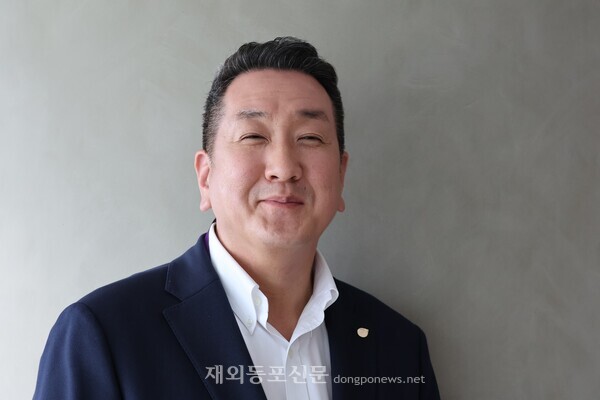
Lee Sunghak, co-founder of U.S.-based PROVEST Partners and a former World OKTA Next Generation alumnus,
who decided to invest 2 billion won in the winning company of the World OKTA-hosted AI startup competition. [Reporter Hwang Bok-hee]
A Korean investor from the next generation of World OKTA (World Federation of Korean Economic and Trade Associations) invested 2 billion won in a startup discovered by OKTA.
Lee Sunghak (48), co-founder of PROVEST Partners, an investment firm based in Atlanta, USA, decided to invest approximately 2 billion won in Wis Medical (CEO Lee Sung Hoon), a startup that won joint first place at the '2026 Global AI Startup Competition' held at Coex Magok in Gangseo-gu, Seoul on March 31.
This competition was held as a side event of the '27th World Representatives Conference and Export Consultation Meeting' hosted by World OKTA. A total of 114 companies applied to participate, and among them, 24 companies advanced to the finals to compete. As a result of the final evaluation, 'Wis Medical' and the Canadian company 'Mion Forest' shared the top prize.
CEO Lee participated as a judge in this competition, following the '2025 OKTA Global Startup Competition' held in Songdo, Incheon last October. He explained, "I met with various startups at last year's competition as well, but I could not find a company that would lead to investment. In this competition, however, I discovered a company that possesses both technological prowess and business potential, leading me to make an investment decision."
In an interview with this publication held at COEX Magok on April 1, CEO Lee shared his thoughts, saying, “It seems that a virtuous cycle has begun in which we are now returning the help we received during the OKTA Next Generation era through investment.”
A 15-year relationship that began with the OKTA Next Generation
Representative Lee's connection with OKTA began about 15 years ago during the Atlanta Next Generation activities.
After starting his activities as a Next Generation member of the Atlanta Chapter, he also participated in a government-supported homeland visit program the following year. He says that the educational programs and networking experiences held in Korea at the time served as a significant turning point in his subsequent global business endeavors. Since then, he served as the Chairman of the Next Generation Committee and Secretary General of the Atlanta Chapter, took on the role of Chairman of the Chapter Board the year before last, and is currently serving as an Auditor for the Atlanta Chapter.
CEO Lee said, “I was able to broaden my perspective on global business through educational programs and trade-related training conducted in Korea during my time as a next-generation entrepreneur,” adding, “I was able to see and learn firsthand how Korean businesspeople operating overseas utilize their networks to expand their businesses.”
He continued, “The education and networking experience I gained at OKTA at the time became a significant asset while doing business in the U.S. later,” adding, “That experience eventually led to investing in Korean startups.”
From founding an accounting firm to establishing an investment company
After graduating from the Department of Economics at Korea University, CEO Lee worked in Korea for about a year before moving to the United States. After building a career in the accounting field, he co-founded an accounting firm in Atlanta about 10 years ago with accountant Yongseok Kwon, who is also a member of the Next Generation.
Currently, this accounting firm operates eight offices in the United States and has grown to a size of 70 to 80 employees. It also maintains an office in Korea. While running the firm, he naturally began the work of connecting Korean startups with U.S. companies.
“As I connected U.S. corporate clients with Korean startups, I often saw synergies between the two. I thought it would be beneficial to go beyond simple introductions and support both investment and entry into the U.S. market.”
Based on this experience, I founded the investment company 'PROVEST Partners' about four years ago.
PROVEST Partners supports Korean startups in entering the U.S. market and plays a role in connecting investment and networks. To date, the investment scale is approximately 15 to 20 billion KRW, and it invests in both U.S. companies and Korean startups.
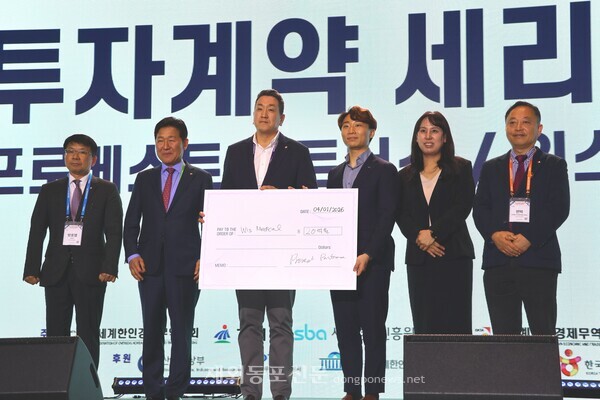
At the closing ceremony of the '27th World Representatives Conference and Export Consultation Meeting' hosted by World OKTA at COEX Magok in Seoul on April 1,
Lee Sunghak, CEO of Probest Partners (third from the left), poses for a commemorative photo after presenting an investment pledge to Lee Sung Hoon, CEO of Wis Medical (fourth),
the winner of the AI startup competition. To the left of CEO Lee Seong-hak is Park Jong-beom, Chairman of World OKTA, and on the far right is Sun Park, Chairman of the Global Startup Committee.
Investing based on technological prowess and global scalability
'Wis Medical,' the company he invested in at this competition, is a healthcare startup that develops sleep monitoring technology. The company has developed technology that measures sleep data using a skin-attached patch and analyzes sleep states through AI analysis. Its key feature is that this technology enables polysomnography, which is traditionally centered in hospitals, to be performed at home.
CEO Lee cited technological competitiveness and global scalability as the background for the investment decision.
While there are many companies offering sleep analysis technology, there are not many capable of measuring hospital-quality data at home. We made the investment decision based on their technological capabilities and market potential.
In particular, he cited the potential to enter the U.S. market as an important criterion.
It is rare for a business model that succeeded in Korea to work exactly the same way in the United States. What matters is whether the model can be adapted to suit the U.S. market environment.
The Korean startup environment is already good enough.
CEO Lee gave a positive assessment of Korea's startup environment.
Korea has very well-established startup support programs and government assistance. The environment, including office space and funding, is much better than expected.
However, he emphasized that strategies for Korean startups to expand into the global market will become increasingly important in the future. “Because the Korean market is small, they eventually have to go overseas,” he said, adding that “overseas Korean networks can play that connecting role.”
He also revealed his vision to create a structure in the long term where overseas Koreans invest and leverage regional networks to help Korean startups expand globally.
Korean startups possess sufficient competitiveness in both technological capabilities and the startup environment. I believe the key now is building networks to expand into the global market.
CEO Lee expressed his expectation, stating, “If a structure is established where Korean businesspeople around the world jointly support investment and market entry, there will be more global success stories for Korean startups.”
Reporter Hwang Bok-hee
dongponews@hanmail.net
Posted 2026.04.01 22:05
Updated 2026.04.04 12:35
https://www.dongponews.net/news/articleView.html?idxno=57147